

Special Features - Blu-Rays
Confessions of a Physical Media Collector

This article was originally posted on 4/7/2024 on CenterHouseStudios.com. Small edits have been made for the sake of coherence for new readers. Please enjoy!
Introduction
You ever stop and think about how crazy it is that something exists? Today, I inserted a high-density optical disc into a cutting edge piece of video game and media hardware. By doing so, I was able to watch a film created over a century ago, in a country nearly five thousand miles away from my own. A film made before sound and before color. It’s doubtful whether anyone who watched this film the year it was released is alive anymore, let alone those who actually created it. Yet, there I was, watching it in the comfort of my own home.
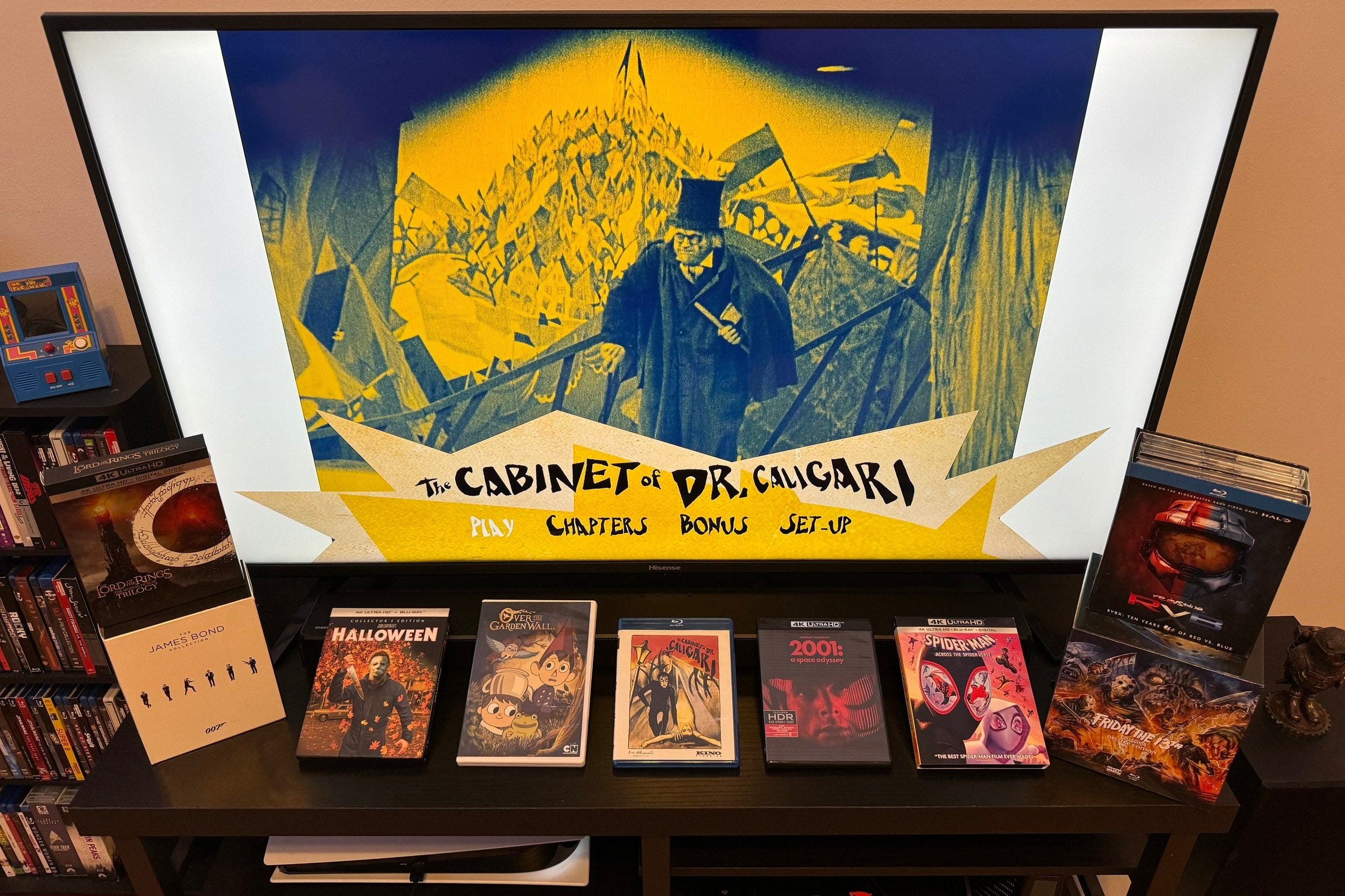
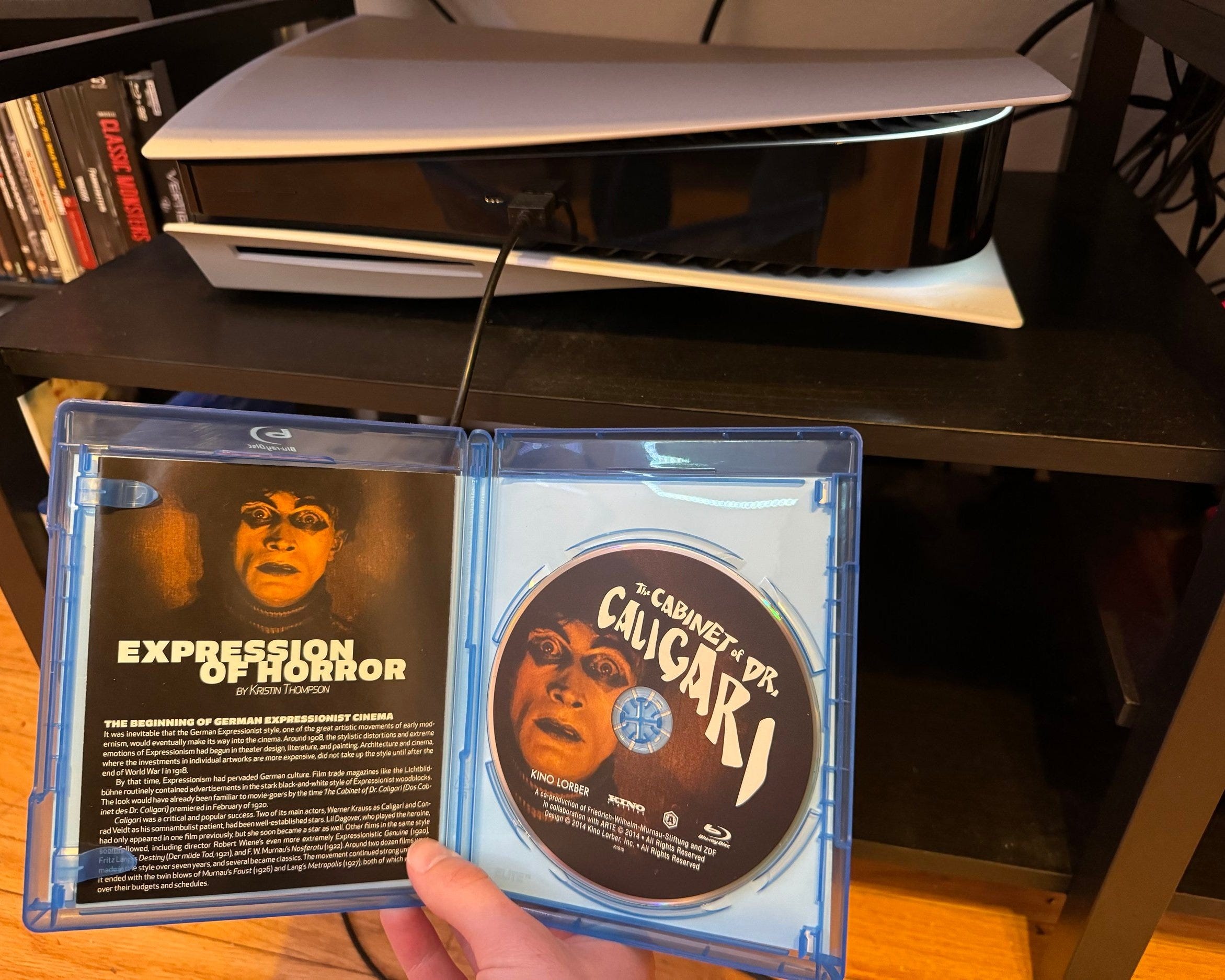
In less technical language, I put a blu-ray disc into my PlayStation 5 in order to watch Robert Wiene’s 1920 silent horror classic, The Cabinet of Dr. Caligari. This is a widely available product. Anyone who wants to can buy this disc and watch a pristine presentation of a work of art that was created one-hundred and four years ago using a material infamous for being highly flammable. That’s pretty crazy if you ask me. I feel like we don’t always appreciate things like that. The ways that we are able to preserve works of art and present them for modern audiences. While there are works of art and history that have been preserved in different forms for far longer than the medium of film has even existed, I have always been drawn to physical copies of movies and television shows. Sure, due to its status as a public domain film, you can watch The Cabinet of Dr. Caligari pretty much anywhere, even for free on YouTube. But, in my view, there’s something special about watching this film, or any of the films that I love, on a blu-ray disc.
I have what I would consider a relatively modest collection of blu-rays, 4K UHD discs, and DVD’s. Approximately two hundred and eighty films on some form of physical media. That sounds like a lot, but it’s only two small shelves worth. Still, I’m very proud of my collection and pretty passionate about it. So passionate about it, in fact, that I often find myself wanting to talk endlessly about all the perks, quirks, and frustrations of collecting home video to anyone I can get to listen to me. Unfortunately, it can be hard to find someone willing to listen to me talk endlessly about things that are as niche and nerdy as blu-ray collecting. But then I remembered that I have my own blog. So, I decided to create a series of articles where I can talk as long as I want about all the various ancillary aspects of art and media that only I seem to care about.
Welcome to Special Features. Today’s subject: blu-rays and why they are awesome.
Let’s get into it.
Origins of a Collector (Or, How I Ruined My Own Life)
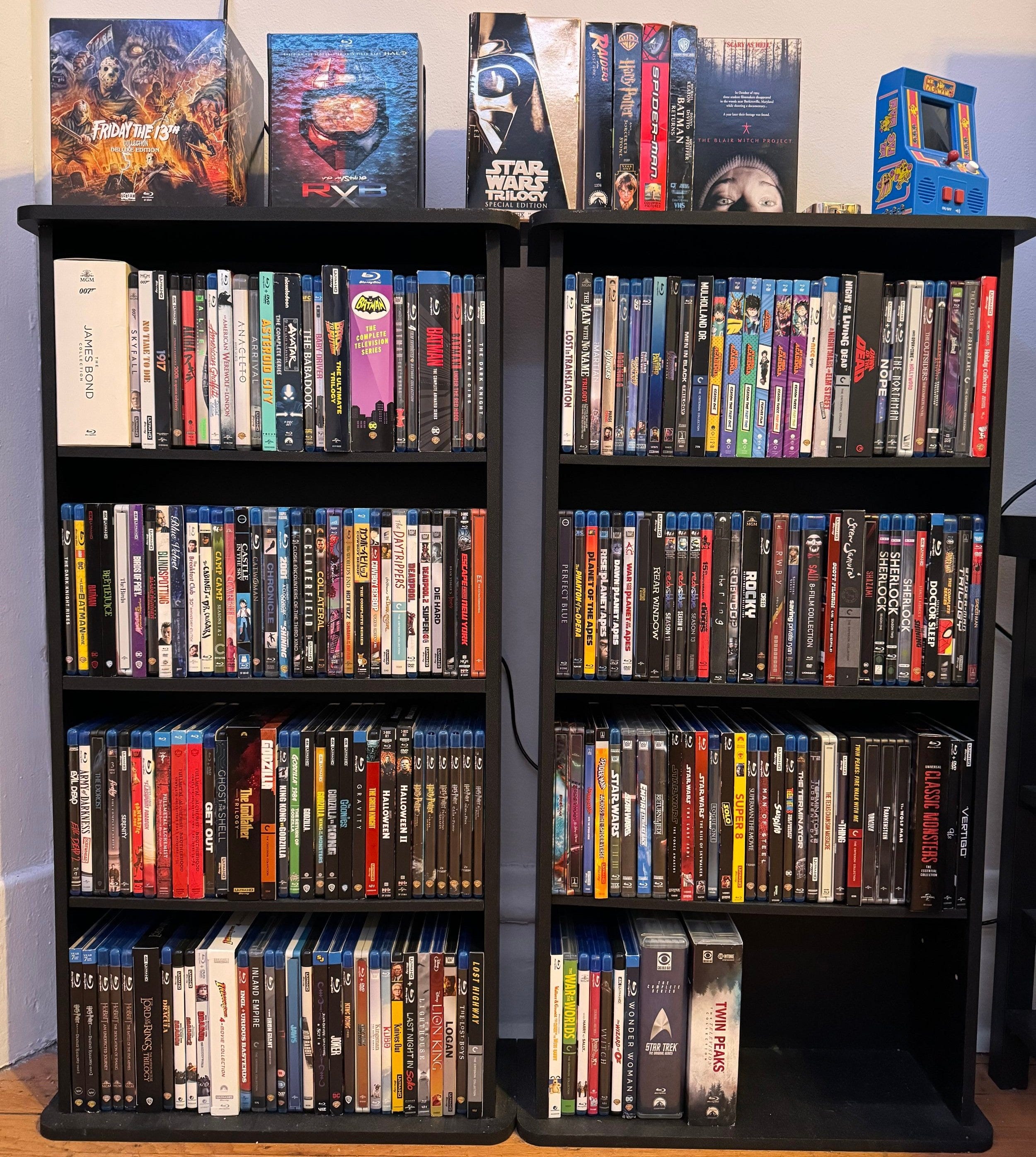
Approximately 293 movies and counting.
For about as long as I can remember, I have loved watching movies. Now, some of that early love certainly came from the big screen. My parents did take me to the movie theater frequently from a young age. I have formative memories of what it felt like to walk into a place that always seemed larger than life, with previews for movies I’d likely never see, sound that was always a bit louder than I was comfortable with, and the smell of popcorn permeating the air. The movie theater was certainly a special place for me, even back then.
But it wasn’t where I watched the most movies. Not back then and not now. I was lucky enough to have parents who were able and willing to take me and my siblings to see a new movie every now and then, but it wasn’t like we were going every week. Most of the time, if I was watching a movie, it was at home. Most of the time, I wasn’t watching movies on live television either. No, if I was watching a movie, chances are I was watching it on DVD. Or maybe even VHS for some specific movies. Regardless, much of my early cinema experiences were via home video.
I spent my early childhood in what was pretty much the last few years before streaming. My television access was fairly limited, per my parents and my status as the first born. I didn’t really have access to an endless library of movies when I was growing up. I wasn’t exposed to something new every day. My parents had a modest DVD and VHS collection and they soon got in the habit of buying me and my siblings DVDs as presents. For much of my childhood, watching a movie meant picking out a DVD from the shelf and putting it in the player. It’s weird to think that I’m part of what will probably be the last generation to have that as part of their youth.
Then there were the VHS tapes. My parents had a fair amount of these, up until I was ten years old. It was actually through these that I was first introduced to Star Wars. My parents showed me the original trilogy via their VHS copy of the special editions. Yeah, I have a feeling that nobody born after my siblings and I can say that they were introduced to any movie via a VHS tape.
In any case, my love for film has always been closely tied to the experience of watching something on home video. Physical media, as it’s commonly referred to nowadays. I have my love for movie theaters as well, of course, and I have had plenty of experience watching films on live TV and streaming. But, to me, there’s nothing quite like owning a movie you love in physical form. When I was a kid, that meant DVDs. There was a time where my parents would motivate me to do well in school (or at least not get into trouble) by promising a DVD copy of a movie I liked. So, even before I was old enough to be buying them myself, I already had a bit of a physical media collection built up. When I did reach the age where I could start spending my own money on movies, that meant blu-rays.
Blu-rays first became introduced to my family because of Star Wars. When my family moved to Seattle in 2011, they decided it was time to get rid of the VCR and all of our videotapes. That meant that we were without a way to watch the original trilogy. I already had the prequels on DVD, but by the time that we had moved, the DVD releases of Episodes IV, V, and VI were apparently getting hard to find. So, at my suggestion, my mother decided to give my Dad our family’s first blu-ray player and a blu-ray set of the original Star Wars trilogy for his birthday. That’s right, I have the VHS format to thank for introducing me to Star Wars and I have Star Wars to thank for introducing me to the blu-ray format.
I was pretty excited to have a blu-ray player, as I had been seeing ads on DVDs that showed off how much better they supposedly were. At first, the Star Wars discs were the only blu-rays my family owned, but it didn’t take long for my parents to start getting us blu-rays as presents rather than DVD’s. So, while I was in middle school, our physical media collection was slowly shifting from primarily DVD’s to primarily blu-rays.
But at that point, I wasn’t really focused on physical media as my primary method of watching movies. When I was in middle school, I was just as likely to be watching movies through DVR recordings on TV or on Netflix streaming. I did occasionally get a blu-ray or DVD for myself, but it was usually just for films that I didn’t have easy access to through other means. Actually, I was a lot more interested in purchasing movies on iTunes at that time, because I liked the idea of having the ability to watch movies or shows anytime on my iPod touch. During this time, my family’s home video collection was a bit sporadic and all over the place. For example, I had the first, third, fifth, seventh, and eighth Harry Potter films on DVD, but the rest were recorded on our DVR. I wasn’t really trying to have all the movies in a series I liked in one format.
That was my cinematic status quo until the end of my eighth grade year. This was the point where I was really starting to develop my own specific tastes in media. During this time, I got really into three specific pieces of media. Scott Pilgrim, Firefly, and Red vs Blue. I think part of my interest in all these properties was because of how niche they felt. I had just happened upon the Scott Pilgrim comics in the library one day, discovered Firefly through a YouTuber, and came across Red vs Blue while browsing for movies on iTunes. They all felt like something that I had truly discovered for myself. Maybe that’s why I really wanted to have some sort of ownership over them. I had seen the Scott Pilgrim movie on TV and read the comics by checking them out from the library. I had already watched Firefly on Netflix, recorded Serenity (the show’s follow-up movie) onto my DVR, and Red vs Blue was available on several different websites, including YouTube. They were all very accessible, but for whatever reason, I decided that I had to have my own copy of each of them.
I started buying the hardcover color editions of Scott Pilgrim (not the cheapest investment), ordered blu-rays of Firefly, Serenity, and Scott Pilgrim vs the World on blu-ray, and Red vs Blue…well, over the course of that summer, I collected every season of the show, either on DVD or on blu-ray. Despite RvB being a web-series, I was determined to have a physical copy of it. The ten-season blu-ray set was too expensive for me, so I instead bought the first ten seasons on the various DVD sets and the remaining three seasons individually on blu-ray. One could probably argue that all these purchases were a waste of money, but I have never regretted any of them. In fact, these were some of my favorite blu-rays and DVDs.
After that, I became more conscious of my appreciation for physical media. I started to realize that a lot of the other teenagers I knew didn’t own movies on disc like my family did and most of my friends didn’t seem to want to. I remember being asked by friends why I wanted to own stuff on blu-ray when it was easily available online. At the time, I didn’t really know how to answer that aside from the fact that I liked the special features that were typically included on the discs. But, going into high school, I started to take my family’s collection (or “my collection” as I was increasingly the biggest contributor to it) more seriously.
Unfortunately, just as my dedication to blu-rays was increasing, I was separated from my collection for a while. My family moved us from Seattle, WA to Granada, Spain for my sophomore year of high school. Among the much more legitimate challenges this change brought was the fact that I had to leave my developing home video collection behind. I brought a handful of blu-rays with me, but I mostly had to stick to streaming for my entertainment fix during our year there. That being said, my passion for blu-rays continued to grow during our year abroad. Even though I was limited in what I could buy, I frequently browsed the various department stores and used media shops in downtown Granada for whatever blu-rays caught my eye. Not only did I buy a couple of Spanish films, but it was here that I purchased nearly all of the Harry Potter movies on blu-ray. To this day, the copies of the Potter films in my collection are these Spanish blu-rays.
Another significant development during this time was my discovery of anime. Or, at least, my discovery of the fact that I liked anime. Because of this…let’s call it “corruption”, I found a new niche of the physical media landscape to invest in. I really wanted to own blu-ray copies of my favorite shows. Unfortunately, as I was in Spain, I was unable to realize these desires for the most part. While most Spanish copies of American or British films came with the original English audio track, the original audio tracks for any anime that I wanted to buy were all in Japanese, obviously. So, I ended up spending a substantial portion of that year in the aisles of El Corte Ingles, staring at all the anime blu-rays that I wouldn’t be able to watch.
Of course, after the year had elapsed, my family returned to the States. Back home, the blu-ray fever that had been building up during my time abroad would be unleashed. During my junior and senior years of high school, if I wasn’t spending the money I made babysitting on Nintendo Switch games, I was spending it on blu-rays. I was finally able to buy some of my favorite anime on blu-ray, I would continue to receive new releases on blu-ray as Christmas and birthday presents from family, and my expanding taste in film during this period led to me buying several classic films on the format. It was an exciting time, when each new blu-ray that I bought felt immensely exciting to own and I would frequently spend my nights watching different movies and shows in my family’s basement.
By the time I left for college, my collection was starting to get impressive. At least, impressive to normal people who had psychologically healthy hobbies. The bookcase provided for me in my college dorm was overflowing with different blu-rays, which were frequently a topic of conversation with anyone I invited over. Attending college in Chicago also had the benefit of allowing me easy access to used media stores for the first time in my life. As such, my collection would continue to grow and grow.
But the biggest period of growth for my blu-ray collection was during the pandemic. Being restricted to spending time indoors for over a year led to me watching even more movies and, therefore, buying more blu-rays. My love for the horror genre really blossomed during this time, so I started getting blu-ray collections of various horror franchises. Additionally, this was the time I bought my first television, a 4K television, no less. Because of this, I found myself itching to start a new collection. 4K UHD blu-rays, the most advanced format one could watch movies in.
I started buying new movies in 4K and upgrading some of my old blu-rays. I bought a sound bar, trying to make my humble home theater as great as I could with my limited budget. I had to buy new shelves that could fit all of my movies. There was no denying it, I was a blu-ray collector. That pretty much brings us to today. While the amount of blu-rays and 4K’s that I buy has receded a bit as my other financial responsibilities have increased, they’re still my favorite hobby. I’m not sure if I’ll ever stop collecting them, I definitely don’t want to.
W.T.F. is a Blu-Ray?
It occurs to me that about sixty percent of this article so far might be a bit obtuse to anyone who hasn’t had films on physical media as an omnipresent part of their lives. At the very least, given that this blog series is meant to consider ancillary aspects of art and entertainment that aren’t always afforded focus, I should probably do a brief overview of what blu-ray and its adjacent home video formats actually are. Now, I’m certainly no expert on the technical side of blu-ray and other film formats, so I’ll be keeping this in terms that you and I can both understand. Sound good?
So, let’s say you’ve just made a movie. You’ve shot it, edited, and released it in theaters. It did pretty well. But a movie theater only plays a movie for so long. Usually just a few months nowadays. Eventually, other movies get released that take your film’s place in the “Now Playing” tab on Regal’s website. So now, nobody can go see your movie in theaters. So how can they watch your movie? Well, in the year 2024, they’ve got a few options.
Most people will now look to streaming to watch your movie. Maybe your film gets dropped on Netflix. That’s probably the manner in which most people will be viewing your movie nowadays. But, the film could also get broadcast on television. Maybe it becomes a fixture of a channel like FX or Freeform. But both of those methods of distribution, like screening in a theater, are ultimately temporary. Sure, Netflix could end up holding the rights to stream your movie for a long time, but it could always be removed from the service. FX or Freeform could stop airing your film regularly.
For people like me, who really like your movie and want to be able to watch it whenever they want, there are two options. We could purchase a digital copy on an Internet storefront like iTunes or Amazon Video. This can be a pretty convenient option, as we can watch your movie from anywhere so long as we have access to our account and there’s less of a likelihood of suddenly not being able to view the film anymore. But, ultimately, it’s still a somewhat impermanent method of distribution, as the person who purchases the film on iTunes still doesn’t technically own it. The provider can remove the film from their services at anytime, with the customer unable to do anything about it.
This leaves one more (legal) method of watching a film. One more way for you to effectively distribute your movie. Physical media. In the past, this could mean VHS and Beta-Max tapes, laser-disc and CEDs, or PlayStation Portable UMD’s. In the present day, physical media for movies primarily means DVD, blu-ray, and 4K Ultra-HD blu-ray. These are what we’re talking about today, primarily using the catch-all term “blu-ray.”
Film has become an increasingly digital medium since the turn of the century. Digital cameras and projectors have largely replaced the use of celluloid, computers are used to edit movies and create many of the special effects, and film distribution has largely relied on digital mediums such as online streaming and the disc formats. Blu-rays and 4K discs are both evolutions of DVDs, which themselves descended from the CD format that transitioned music from analog to digital. All of them function the same way, more or less.
Nowadays, a film exists and is distributed primarily as a digital file. Unless a theater goes out of their way to screen movies on 16mm, 35mm, or 70mm celluloid film using an older projector, you are likely going to view a film digitally, regardless of whether it was shot on film or not. Despite there being some aspects of celluloid that make it ideal for creating and presenting the strongest image (though your mileage may vary on that), the convenience and low-cost of digital make it the obvious choice from a business perspective. It certainly makes for a more customer-friendly product. DVDs merely require someone to insert the disc into a box that’s plugged into their TV and hit a couple buttons on a remote. Streaming a film only requires clicking a mouse a couple times. Films existing primarily as digital files has made them more accessible (in theory) than they have ever been. It made DVDs, blu-rays, and even 4K discs an affordable way for anyone to purchase their own personal copy of a movie.
So how do those DVDs, blu-rays, and 4K discs actually work? Well, in layman’s terms, the film is stored as a digital file onto the disc. The disc is placed in a protective case to be sold in stores or shipped directly to the customer. The customer then either has the choice of keeping the disc in its case on a dedicated shelf (or box or wherever they want to put it) or throwing the case away and keeping the disc in a small binder full of all of the other discs they own. I have not met anyone who uses physical media in 2024 who actually does this, but I know from experience that people used to do this and I find it just a little atrocious.
Anyway, when the owner wants to watch the film, they take the disc out of the case and put it in their player. This could be a dedicated DVD, blu-ray, or 4K player or something like a video game console that has disc playback for movies as a feature (I have a PlayStation 5, which plays 4K discs, blu-rays, and DVDs). This player is connected to a TV (or projector, or computer display, or perhaps its own portable display) and reads the data off of the disc. Once this happens, you typically get a studio logo, possibly some legal warnings, maybe a preview or two for other movies, and then you get to the disc’s menu. This is where you can play the film itself, adjust the language settings for the film (I tend to turn on subtitles; I like to read), or access any special features (hey, that’s the name of the series!) that the disc may contain. Once you play the movie, the player accesses the movie’s digital file and displays it on the TV, allowing you to watch the film in what is likely the best looking and sounding format available to you outside of a movie theater.
I won’t get too deep into why physical media formats, particularly blu-rays and 4Ks, are often considered superior to streaming and broadcast from a technical standpoint. Keeping it simple, the amount of storage data that can fit onto a blu-ray or 4K disc is much larger than the file sizes that can typically be streamed or even downloaded onto your phone or computer. Larger file sizes allow for a better looking image and better sounding audio. While streaming has pretty firmly eclipsed DVDs in terms of quality (the format is over two decades old, after all), it has yet to truly overtake blu-ray, particularly in terms of sound, and is definitely still behind 4K discs in both image and audio. While it’s possible that streaming could eventually match physical media in terms of visual and auditory fidelity, Internet speeds and the cost of data storage on the internet will likely be holding it back for the foreseeable future.
So, blu-ray and 4K are both technically superior to the average stream. That’s cool, but how do they compare to each other or to DVDs? What does 4K mean? What even is a “blu-ray?” At first glance, the different formats all look the same. They’re all discs that use the same fundamental technologies to house and output films, just at varying levels of fidelity. The data stored on the disc is read via a small laser, allowing it to be displayed on screen. For DVD’s, this laser was red, but a more advanced blue laser was created to read blu-ray and 4K discs, hence the name. The blue (technically violet, but I guess “blu-ray” sounds better) laser that reads the discs allows for more storage than DVDs. The main way the difference in storage space between DVDs, blu-rays, and 4K discs manifests is the resolution of the film’s image. A digital video file is primarily defined by the amount of pixels it displays on each frame. These tiny dots make up the images that you see when you watch the movie. The higher the resolution, the sharper and more detailed the image becomes.
The DVD format displayed movies in standard definition (“SD” for short). This meant there were typically 345,600 pixels, commonly referred to as 720x480p. Standard definition looks fine, DVDs looked better than VHS tapes for sure, but it didn’t hold up to how films looked in the theater. Blu-ray got us a lot closer. It was an HD format, meaning that it could display images with 2,073,600 pixels, or 1920 x 1080p. This is now the standard resolution for online streaming and television broadcast (with caveats regarding the capabilities of both formats). HD looks good, better than anything ever had outside of a movie theater. New TVs were made with this resolution in mind, transitioning us from the big boxes of yesterday to flatscreens and LED displays. These days, anything in standard definition will look out of date to the average viewer. But, as good as HD looks, there was still room to improve.
1920 x 1080p can be shortened to 2K. Double the amount of pixels and you have a 4K image. Consisting of 7,515,800 pixels, or 3480 x 2160p, 4K slowly emerged over the 2010’s to become the preferred resolution of gamers and movie fans alike. 4K image allows for pretty much the highest level of detail and crispness that you can get out of a moving picture. I’m not kidding, the human eye basically cannot process the difference between any video resolutions higher than 8K. If a movie was shot on celluloid film, 4K transfers that image to digital in pretty much the best way possible. In addition to raw resolution, 4K blu-rays also allow for the most dynamic and impressive color and audio presentation. While obnoxious film goers like me will still advocate for the benefits of watching a film projected on 35mm or 70mm celluloid in a theater, watching a 4K movie on a decent screen has pretty much an equivalent, if not a bit cleaner, quality. Granted, the leap in quality between 1080p HD and 4K UHD isn’t quite as obvious as the difference between SD and HD, but 4K is still indisputably the best way to watch a movie in the present day.
There are definitely more things I could talk about. I haven’t even touched on how audio improved across the different formats. But, I’m ultimately more interested in discussing the broader experience that one can have with blu-rays and 4Ks rather than getting into the nitty-gritty technical stuff. Maybe in another installment of Special Features, I can go deeper into things like how the quality of a film transfer can impact a blu-ray or the lost art of the DVD menu. But for now, I’d like to transition from talking about what the blu-ray format is to discussing why I prefer it to other methods of watching movies.
The “Deal” with Physical Media
If you’ve made it this far, you might be thinking, “okay, I know what these stupid discs are now, but what’s so great about them?” It’s a fair question to ask in this day and age. What’s the point of paying twenty to thirty dollars for one movie when you can get access to hundreds or thousands by paying a streaming service ten to twenty a month. Believe me, I lay awake at night asking myself that question.
Alright, I already touched on the technical reasons that make blu-rays the superior option to streaming or even television broadcasts of films, at least for pedantic assholes like myself. I could go deeper into that stuff, but to be perfectly honest, none of that is why I started collecting and it’s not really the reason I still do. Don’t get me wrong, there is definitely a difference in visual and auditory quality between a blu-ray and a 1080p stream on Netflix, one that I’ve only gotten better at noticing as I’ve gotten older. But, it’s not like I’ve sworn off watching any movie via a streaming service. I definitely still do and, for the most part, I find watching a movie this way to be perfectly acceptable. Most people probably wouldn’t be able to tell the difference, or wouldn’t really care. So I don’t think pitching a blu-ray or a 4K blu-ray strictly on visual fidelity is ever going to be a strong pitch to the average moviegoer.
However, I do think owning physical media offers a number of other advantages over streaming. For one thing, there’s the matter of actual ownership. The digital age, despite having the potential to make films easier to access than ever, has seen studios and streaming services wield their considerable power to effectively erase certain movies and TV shows from existence. Even without cases where streaming only content has been removed from digital platforms, there are countless films and shows that just aren’t available for viewing on streaming or digital storefronts such as iTunes. That’s not even accounting for all the times that even widely known films or shows can move between streaming services at seemingly a moment’s notice, creating a scenario where your ability to watch a movie is effectively tied to your continued subscription to one or more services.
The thing is, I get the feeling that most people aren’t actually taking advantage of the fact that streaming services offer an immense library of films and shows and are typically only using them for a couple shows or movies at a given time. How many people were pretty much solely using Netflix to repeatedly watch Friends or The Office, for instance? When you take that into account, the amount of money you spend on streaming services might end up being more than the amount of money you might spend on physical media. With streaming prices only going up and the services mostly getting worse…well, I think there’s a strong argument for at least making sure you own the things you really like in a way that can’t just be deleted at the whims of a corporation.
But even discounting that argument and pretending for a moment that you really could find everything you’d want to on some streaming service, I would still be invested in collecting blu-rays. Because owning a blu-ray means actually owning a copy of the film. It means having it be a part of your collection, your personal catalog of your favorite movies. It means having a physical object that demonstrates your appreciation of a certain movie. It means being able to watch that movie in the best manner available to you. Now, most people probably don’t really care about that. But for someone like me, for whom film is a longtime passion, those things are nice.
Granted, part of my appreciation for physical media is simply the fact that I grew up with it as my primary avenue for watching movies. I never really made a conscious decision to try and collect blu-rays, doing so just felt like a natural way to practice my love of film. By the time I realized what I had started doing, it was too late. I feel like that’s how it happens for most people who collect stuff. They just start out casually buying things or getting them as gifts and they don’t really think about it until they suddenly look at all the stuff they have and think, “what have I done?” But regardless, I just don’t enjoy watching movies on streaming or broadcast as much as I do putting in a blu-ray and taking the time to really enjoy the film.
Let’s talk about that, because I think there’s a lot to consider regarding how one actually views film and television differently between streaming, physical media, broadcast TV, and the movie theater. Here’s the thing. Part of the overarching thesis of this new blog series is that there are ancillary elements to a given work of art that can have an effect on one’s experience with the work of art itself. Watching a film in a movie theater, the environment it was likely created for, can be a substantially different experience than watching it on your cellphone. Depending on the movie, that difference might even influence whether or not you enjoy watching the film in the first place.
Whenever someone would ask me why I would buy a certain movie or TV show on blu-ray, they would always point out that I could watch it on Netflix or some other streaming service. Currently, streaming has had an overwhelming effect on the landscape of film and television, creating a lot of uncertainty for the movie theater, broadcast television, and physical media industries. Obviously, there are a lot of people who have opted to use streaming services for their entertainment rather than go to theaters, pay for cable TV, or purchase movies on disc. But even if streaming has had an effect on all three of those markets, I think it makes the most sense to frame streaming as more of a direct competitor to broadcast television rather than blu-rays or movie theaters. At the very least, I think that’s what streaming was directly trying to replace. Any damage done to physical media or even the movie theater was arguably more of a side effect of streaming’s attempts to supplant television specifically.
If you’re going to compare the four ways that people consume entertainment, then the experience of watching something on streaming is closer to the experience of watching television than either of the other two avenues. Television was designed to either be consumed passively (via turning the TV on and just watching whatever was on casually) or as an event (tuning in for a specific broadcast at a specific time). That’s not too different from how streaming is typically used by the public. The difference is, rather than just turning the TV on and being forced to watch whatever was airing on whatever channels you had available, a person can go to their streaming service and select something specific that they want to watch casually. Rather than having to make sure you’re home at a specific time so that you don’t miss the season finale of your favorite television show, you can choose to watch it at your convenience (or even just watch the whole season at once when it’s all released). Background watching and appointment viewing both occur on broadcast TV and streaming, it’s just that the finer details surround those experiences are different.
Now, we could talk much more at length about the pros and cons of live TV vs streaming. There are definitely arguments in favor of both formats. But that’s for another time, I just wanted to bring it up to argue that streaming isn’t inherently something that directly supplants physical media ownership. Arguably, digital storefronts such as iTunes and Amazon are more threatening to the market, but I feel like the kind of people who would go out of their way to try and own their movies on something like iTunes are also the kind of people who are more likely to want to own the physical copy, especially when blu-rays often come with a digital code anyway.
Because what physical media offers is something that neither streaming or broadcast TV really do. It offers commitment.
Yes, I am going somewhere with this.
When I say commitment, I mean that when I put a blu-ray disc into the player, I am committing to watching that movie. Obviously, if something comes up I could pause it or turn off the TV and take the disc out, but I’m still intending to sitting down for an hour and a half to two hours and fully paying attention to the film I chose to watch. While you can definitely do the same with streaming, the format just doesn’t incentivize you to do that. Streaming is trying to make you casually binge watch a show for hours and hours or just put the occasional episode on whenever you’ve got a half hour to kill. When all it takes to watch a movie is clicking a button on a remote, you’re more likely to check out or switch to something else. At least, that’s what it’s always felt like to me.
That’s not to say that someone should never watch a movie casually or that they should go out of their way to obtain every movie they want to watch on blu-ray. That’s just not feasible or appealing to most people. I mean, I definitely wouldn’t do that. But I do think that films, in general, are better suited to the experience of putting in a blu-ray than they are just watching them on streaming. A film is designed to be a singular experience (at least, that used to be the norm before the cinematic-universe era) and viewing a blu-ray reflects that. I think putting a blu-ray in, watching (or skipping through) all the previews, turning off the lights, and pressing play is the closest one would get to the experience of watching that film in a theater, even without all the technical advantages of the format.
Streaming has always made more sense for TV shows to me. While I have purchased several shows on blu-ray, I only do that for the ones I have a strong attachment to (and are usually shorter than the average series). For everything else, I’m content with streaming, because the convenience matters more to me when I’m watching something with a large number of episodes. I still support every series getting physical releases, at the very least for preservation purposes and so fans can have the option of owning them, but I think the argument for streaming is much stronger for television shows. But with movies, I just feel that blu-rays provide a more authentic experience of the medium.
There was a feeling of excitement that I got as a kid when the lights in a movie theater would dim and the studio logos would appear on screen. It’s a feeling that I still get in a movie theater occasionally if it’s something I’m really excited to see. The closest approximation I can get to that visceral feeling is when I sit back to watch a blu-ray, either one that I just bought that I’m really excited about, or revisiting a film I love that I haven’t watched in a while. I can only get that specific feeling for a movie if I’m seeing it in a theater or if I’m putting in a blu-ray.
Maybe part of the that excitement is that an anticipation builds while you’re waiting. If you’re in a theater, you had to travel to get to it, find your seat, and still probably have to wait through a few previews at least before the movie starts. If you’re watching a blu-ray, it doesn’t take as long and you have more control, but there’s still a bit of time between deciding to watch the movie and actually getting to see that studio logo. An anticipation is allowed build. There are a lot of things that I love about blu-ray, a lot of reasons I go out of my way to collect them. I like seeing them on my shelf, I like knowing I’m watching the films in the best way I can, I like that they don’t rely on an Internet connection, and I like all the fun little quirks and extras that come with them. But I think that sense of commitment and anticipation I get when watching a blu-ray is one of the biggest reasons I appreciate them and hold them as the true alternative to seeing a film in the theater.
I wouldn’t expect everyone to feel the same way. Not everyone is as invested in movies as I am and doesn’t feel a need to try and approximate a theatrical experience when they’re watching something at home. But I do think there is a benefit to physical media film and TV releases that can’t be easily replicated by streaming services. So, if someone reads this and thinks that any of what I’ve described sounds like something they want to experience, I would highly recommend checking out a blu-ray or even a DVD release of a film they like. I’d love to see more people get into physical media, even just a little bit. After all, the market could certainly use it.
Error Reading Disc
While I do firmly believe that blu-rays and DVDs still have a place in today’s media landscape, I can’t deny that physical media has been in a bit of a precarious position lately. Despite all the reasons that I feel it’s an inferior option for the medium of film, streaming has largely supplanted both physical media and live television as the way most people view entertainment nowadays. Blu-rays and especially 4K’s are increasingly niche, only being purchased by dedicated collectors. More and more major stores that used to dedicated large sections of floorspace to home video are cutting back or dropping out of the market entirely. For example, Best Buy, the place that I bought many of my movies from, is in the process of ceasing all sales of blu-rays. I’d be lying if I said that doesn’t feel a little apocalyptic.
For a while, even the studios themselves seemed less and less interested in keeping up with physical media releases of their films. Several popular shows and movies have been streaming exclusives, films are released for purchases on services like iTunes weeks before they’re available on physical, and a lot of physical releases have felt like there’s less and less effort put into them, especially regarding things like special features. That can be pretty disheartening, especially as the severe drawbacks of streaming have become more and more apparent these past couple years.
But, it’s not all hopeless. Sure, the general public may not have much interest in owning a surplus of movies on home video, but the collectors market is probably stronger than it’s ever been. Boutique labels have been putting out excellent blu-ray and 4K releases of all kinds of films for years now. Criterion, Arrow Video, Second Sight, Vinegar Syndrome, Shout (or Scream) Factory. These companies are doing some impressive work to preserve movies and provide the public with quality physical media.
Even beyond the collector market, there are signs that physical media might be starting to regain some ground from streaming. Disney, the public face of corporatism in the film industry, has begun putting out 4K blu-ray releases of films and series that were previously streaming exclusives. The flagship titles of Disney Plus, their Marvel and Star Wars streaming shows, have gotten actual full fledged physical media releases. If the Mouse views it as worth their while to start releasing content from their streaming platforms to home video, then I imagine the market can’t be dead yet.
Despite some worrying trends, more and more blu-ray and 4K discs are being announced all the time, both for new movies and classic or cult films. Even if the big storefronts don’t want to sell them, fans clearly still want to buy them. Used media stores and websites dedicated to home video are both great options for people looking to own their favorite movies. While things are definitely in a period of flux, I think physical media is starting to make a comeback that could end up being similar to that of vinyl. I hope it is anyway. Because I really love blu-rays and I would hate to see them fall victim to a media distribution market that has proved to have some real negative effects on the industry in several ways. I don’t think that physical media has to be or even should be the only way to view movies at home, but I do think it’s important to have them as an option, both for the people who love movies and the people who make them.
User Manual
I don’t anticipate all or even a significant amount of installments of “Special Features” to end with a “call to action.” That kind of thing isn’t really what the series is about, I’m mostly just trying to shed some light on aspects of art and entertainment that can be overlooked or taken for granted. But in this instance, I would like to encourage anyone who’s even mildly interested in the formats to consider getting some movies on physical media. Not everyone is gonna have an interest in owning a physical copy of a movie they like, but if what I talked about in this article resonated with you, I don’t think it could hurt to try it out. But before I sign off, here’s some advice from a fairly experienced collector.
1. Don’t Stress About the Format - If you haven’t ever owned any movies on physical media before, you might be wondering where you should start. I’ve gone over some of the technical differences between DVDs, blu-rays, and 4K UHDs, but at the end of the day, all three formats are good options to collect right now. Pretty much any movie you’d want to buy is going to have both a DVD and a blu-ray release and while not every major film has gotten a 4K release, many have. If you invest in a player, you’re going to have plenty of options regardless of the format.
That being said, I would recommend blu-ray as the ideal format to start with for someone who hasn’t had any experience collecting movies on physical. While DVDs usually don’t look bad, 1080p HD is pretty much the standard for any media you’re going to come across nowadays, so blu-rays are going to look and sound “just right” while DVDs won’t look as good as the average streaming service. While 4K is technically better than blu-ray from a audio/visual standpoint, the difference isn’t as immediately apparent and is really only beneficial when one already has a 4K television and a decent sound setup. Plus, 4K players are still pretty pricey, while the average blu-ray player has gotten pretty affordable. I’d only try to collect 4K discs if you already have a 4K television and a PS5 or X-Box Series X, as those have 4K players built in.
Even if you have the option of watching 4K discs, you really can’t go wrong with a standard blu-ray. They’re more widely available, they’re generally pretty affordable, there are more films released in that format, and they still provide a better experience than a stream. Plus, if you have a PlayStation 4 or X-Box One (or even an old PS3), you already have a blu-ray player. But if blu-rays are still out of your reach for whatever reason, DVDs are still a solid option. Sure, the technology is more outdated, but even a 4K player still plays DVDs and they’re still the highest selling physical media format. They may not look as good, but they’ll still provide you with the same kind of experience as a blu-ray or 4K disc.
Ultimately, I would advise you not to let the different formats intimidate you. See what kind of player you have or can easily get and then just go from there. Can’t really go wrong with any option.
2. Buy What You Want - I remember when I was a kid and wishing that I had something to “collect.” I was never someone who was into Pokémon cards or baseball cards or minerals or whatever other junk I hear about people collecting. I felt like I could never start a collection, cause it seemed like too much work for stuff that I wasn’t really all that interested in. I never really considered the option of collecting DVDs or blu-rays until I was well into high school. I didn’t realize I could have a collection of blu-rays until I already did.
What I’m trying to say is, I never set out to build a collection of movies on physical media. I just bought movies that I wanted to own, one at a time, for years until a collection started to take shape. I would recommend a newcomer to the format do the same thing. Instead of getting intimidated by all the different releases of all the different movies released on all the different formats, just ask yourself a question: “what movies (or TV shows) would I like to own a copy of?” Odds are, if you’re marginally interested in collecting movies on physical media, that you already have a fair amount of movies that you like. To start with, I would get movies that you know you like and would want to watch multiple times. Whatever your favorite movies are, try and find out where you can get a copy of them on physical. If you like owning your favorite movies on a certain format, keep getting whatever movies you’re interested in.
Personally, I tend to only get movies that I’ve seen at least once before, because I don’t want to spend money to own a movie I don’t like. But, if it’s something that catches your interest, it can’t hurt to roll the dice on a blu-ray once in a while. I’ve done that a few times and it’s helped me discover some of my favorite films. Most of the time, blu-rays aren’t massive investments. At this point, a lot of them are cheaper than buying a ticket to a movie theater, so I wouldn’t stress about what you should get. Don’t try to “build a collection,” just get whatever movies you want and put them somewhere until you have enough for their own dedicated shelf. Once you reach that point, congratulations, you’re a collector. Have fun with that!
3. Find a Good Store - It’s an interesting time to be buying blu-rays. As I mentioned before, Best Buy has been ceasing their sales of films on physical media, which has had an impact on how I shop for movies. Granted, I haven’t really been letting myself buy a ton of blu-rays recently for financial reasons anyway, but even browsing for movies has been affected. It’s not like I bought all my blu-rays from Best Buy, far from it, but I always found their website to be a good place to pick up newer releases and find some decent bargains on older copies, so I was sad to see them drop out of the market. That being said, there are still some solid options for buying physical media.
The closest comparison to Best Buy that I’ve heard, at least for a combination of brick and mortar stores and online shopping, is Walmart. I haven’t bought anything from there myself, but looking at their website, it seems that they have a pretty sizable selection of 4Ks and blu-rays with some fair prices. I don’t think its necessarily a replacement for Best Buy to me, but I certainly don’t think it’s a bad option.
There’s always Amazon, but I haven’t been impressed with their handling of physical media sales for the last few years. It feels like there’s a decent number of releases that they just don’t carry and even when they do, it can be hard to find them amidst the digital video listings and other products. Plus, I’ve had a few bad experiences with their shipping, whether it’s the cases getting damaged on the way or the blu-ray just not showing up at all. I certainly will still buy stuff from them on occasion, but I would advise any new collectors to look for at least one other shopping option.
An interesting site that has been getting some buzz in the physical media world is Gruv.com. I’ve only ordered from there a couple times, but their selection is pretty good, albeit limited to just a couple studios, and they usually have some solid deals running on a regular basis. I would check them out, especially if you’re starting out and want to get some blu-rays and 4Ks of more recent films.
But, in my opinion, the most fulfilling place to shop for physical media is in a physical store. In particular, used media stores are really fun to look around in. A lot of used video game or music stores also have pretty sizable movie offerings. Granted, you won’t necessarily find everything that you might be looking for, especially depending on what store you have near you (if you have one at all), but you can often find some interesting stuff that you wouldn’t have even known you wanted. I was lucky enough to have a couple used media stores close to where I lived in Chicago and I spent a lot of time browsing their selections. I’ve gotten plenty of blu-rays and even some 4Ks from both and it’s always rewarding to find something that you want for a decent price at a store like that. If you can find any used media stores near you, I would highly recommend checking them out.
Hell, even a thrift store can be a good place to find physical media. A lot of them will have a shelf or two of DVDs, sometimes even a few blu-rays, and these typically have the best prices you’re ever going to find. There’s no guarantee that there will be anything you’ll want, but if you manage to find something, it’s a pretty great feeling.
There are definitely a good amount of options for buying blu-rays right now, even if none of them have anything and everything you’d want to find. My advice would be to find a couple stores, online or in-person, that you can browse through. If there’s something specific that you want and it’s not in any of your usual stores, a Google search will usually be able to track something down for you. Otherwise, just keep an eye out for anything that catches your interest.
4. Don’t Spend Too Much - This one should be obvious, but be careful with how you spend your money. Blu-rays generally aren’t too expensive nowadays, but they can vary significantly in price across different stores. Sometimes you can find something for much cheaper than you would anywhere else at a certain store, but sometimes that same store can overcharge for a movie you could get for under twenty dollars on Amazon. Granted, a few dollars difference isn’t a huge deal, but I still try to look around online before buying a blu-ray from a store, just to make sure I’m not spending more than I need too.
I wouldn’t say that blu-ray collecting is a particularly expensive hobby, I certainly think it’s cheaper than gaming, but there are certainly some releases that could do some damage to your wallet. Obviously, brand new releases tend to be fairly expensive, with 4Ks running up to $40 for a single film. But even worse than a new release is a blu-ray that’s out of print. Those can get quite pricey. Something like the 1978 Dawn of the Dead, that has had rights issues preventing it from getting from being available to watch domestically, has a US blu-ray that costs around $70. I wouldn’t advise anybody to buy something like that. It just isn’t worth the money.
Honestly, I don’t think you should ever spend more than $40 dollars for a single movie. Blu-ray sets are a different story, I’d say as long as the overall price isn’t more than $20 per movie, it’s a fair deal. But either way, I’d be frugal. At the end of the day, these are just movies and none of them are worth stressing yourself or your finances over. If it seems like it’s too expensive, it probably is and you might be better off waiting or seeking a better deal elsewhere.
I’d especially recommend this with releases of mainstream movies from the last twenty to thirty years. Most blu-rays of these kinds of films will go down in price fairly quickly and fairly significantly. Either that, or they’ll get good deals on them during the frequent sales that sites like Amazon and Best Buy have (or used to have in Best Buy’s case). Seriously, keep an eye out for sales, especially Black Friday/Cyber Monday. You can find some great stuff for quite cheap. They’ve certainly been a big help in me growing my collection.
But all that stuff really just boils down to being mindful of how you spend your money. Despite how much I advocate for the “importance” of blu-rays to the medium, they are ultimately disposable, or at least something that should only be bought with disposable income. Don’t let what should always be a fun hobby becoming any sort of financial stress. If there’s something you want that’s too expensive, I guarantee that there’s something that you’ll want that’s much cheaper. You just gotta look for it.
And that’s pretty much all the big advice I’d have for the new collector. I mean, there’s some smaller things, like don’t throw away the cardboard slipcovers, but I’d say any person reading this and somehow actually interested in collecting physical media would be pretty prepared for getting into the formats. If you do, I hope you have fun with it and find some stuff that you like. I’ve been buying movies on disc for a long time and taking it seriously for about seven years or so. Some of it can be a pain in the ass, especially when you’re a stickler for things like packaging, but I’ve had a great time building my collection and I don’t think I’ll ever want to get rid of it.
Eject Disc
Well, we’ve reached the home stretch of this inaugural installment of “Special Features.” It might have gotten away from me a bit, I don’t anticipate every article in this series to reach a word count of roughly 10,650, but I was speaking about a subject that I have a lot of history with and passion for. Home video has been a constant part of my life and one that I’ve dedicated a lot of time and money to. It’s also been something that I’ve rarely been able to discuss with like-minded people. So, having a chance to ramble on and on about it through this blog post has been very fulfilling.
But, if I can connect this back to the overarching theme of this new series, blu-rays and the wider physical media landscape all play a role in how we can experience works of art. As I hope I’ve made clear, watching a film on physical media, whether it’s a DVD, blu-ray, or a 4K disc, is about the closest we can get to the experience of buying a ticket and going to watch it in a movie theater. But it’s also more than that. For a collector like myself, it’s also an opportunity to celebrate your love for a movie. Owning it on physical media also means having a tangible object that can be displayed, supplementary features on the disc that can teach you about how the film was created, and a sense of commitment when you put the disc on that can make your viewing of the film more satisfying.
For the film industry itself, it means preserving a film in a way that can’t be deleted by a corporation or lost due to poor storage conditions. Potentially giving films, and the people who made them, a more direct and sustainable source of revenue compared to streaming. I believe the industry could really benefit from a pivot away from streaming as the end-all, be-all of film distribution and allowing physical media to regain a healthier share of the market. Granted, it’s hard to say whether the general public would be receptive given how used to the convenience of streaming they’ve become, but given all that we’ve been hearing about how unsustainable the current model is, I’d say something has to give sooner or later.
There are many other aspects to blu-rays and the wider world of home video that could be the subject of other “Special Features” installments. But for now, I’ll leave you with this. If the proper way to experience the average movie is by watching it on the big screen, then I would argue that the blu-ray is the ultimate distillation of that film and that experience. Having the film and all sorts of material dedicated to its production housed in one package, in the best presentation that technology allows, is something really special to me. While a film is not something that exists in just one tangible form, a blu-ray is the closest thing to that. It’s an object that I can hold, that I can collect, that represents and contains a film that I am passionate about. That’s why I find it meaningful to the experience of watching film.
Physical media and home video is something that people take for granted nowadays. It’s existed in some form for so long, we forget that it’s still relatively young compared to the history of film as a whole. It used to be that you could only watch a film while it was playing in a movie theater. Once it left it’s initial run, you wouldn’t be able to see it again unless it was popular enough to get a re-release sometime down the line. Even when television allowed for viewing a film at home, you were still unable to control the time that you’d be able to watch the film, and even then you’d only be able to watch it maybe once or twice a year.
VHS, and all the accompanying formats, changed that. You could rent or buy a film whenever you wanted, bring it home and watch it as many times as you wanted. You had control over the experience, you could pause to take a break or rewind to watch your favorite scene over and over. The newer formats brought even more quality of life features, such as subtitles or scene selection. Special features made it easier to learn about a film’s production, acting as a pseudo-film school for those aspiring to the craft (such as myself). The quality of the film’s presentation on each format got better and better, to the point where a 4K blu-ray on a good screen can rival some movie theaters. That’s pretty crazy to think about when comparing it to a VHS tape on a big box TV from 1987.
But despite how crazy it is that these technologies exist, they aren’t really appreciated. Sure, they sell a decent amount, but we’ve largely allowed streaming to supplant physical media despite it being, in my opinion, a much less satisfying cinematic experience. So, even if this post hasn’t made you want to go out and spend a ridiculous amount of money building a collection of twenty-four thousand blu-rays, I hope it’s given you cause to think about how these high-density optical discs can play an important role in the film industry and help make one’s experience with a certain film all the better. Writing this has certainly helped me appreciate them more, and I already loved them.
At the end of the day, blu-rays are just another part of the film industry. But even those small facets of the wider world of movies and television can be important. Whether the physical media market sticks around or falls victim to the encroachment of the Internet is ultimately something I can’t predict. But, no matter what, they’ll always be a part of film history. They’ll always be a Special Feature.
That’s it for the first installment of “Special Features!” I hope you enjoyed the article, I promise they won’t all be as long as this one. Please subscribe to receive future installments of this new series sent straight to your inbox!
See you next time!
-R
Just fyi, I don't think you can watch Friends or The Office on Netflix anymore?